
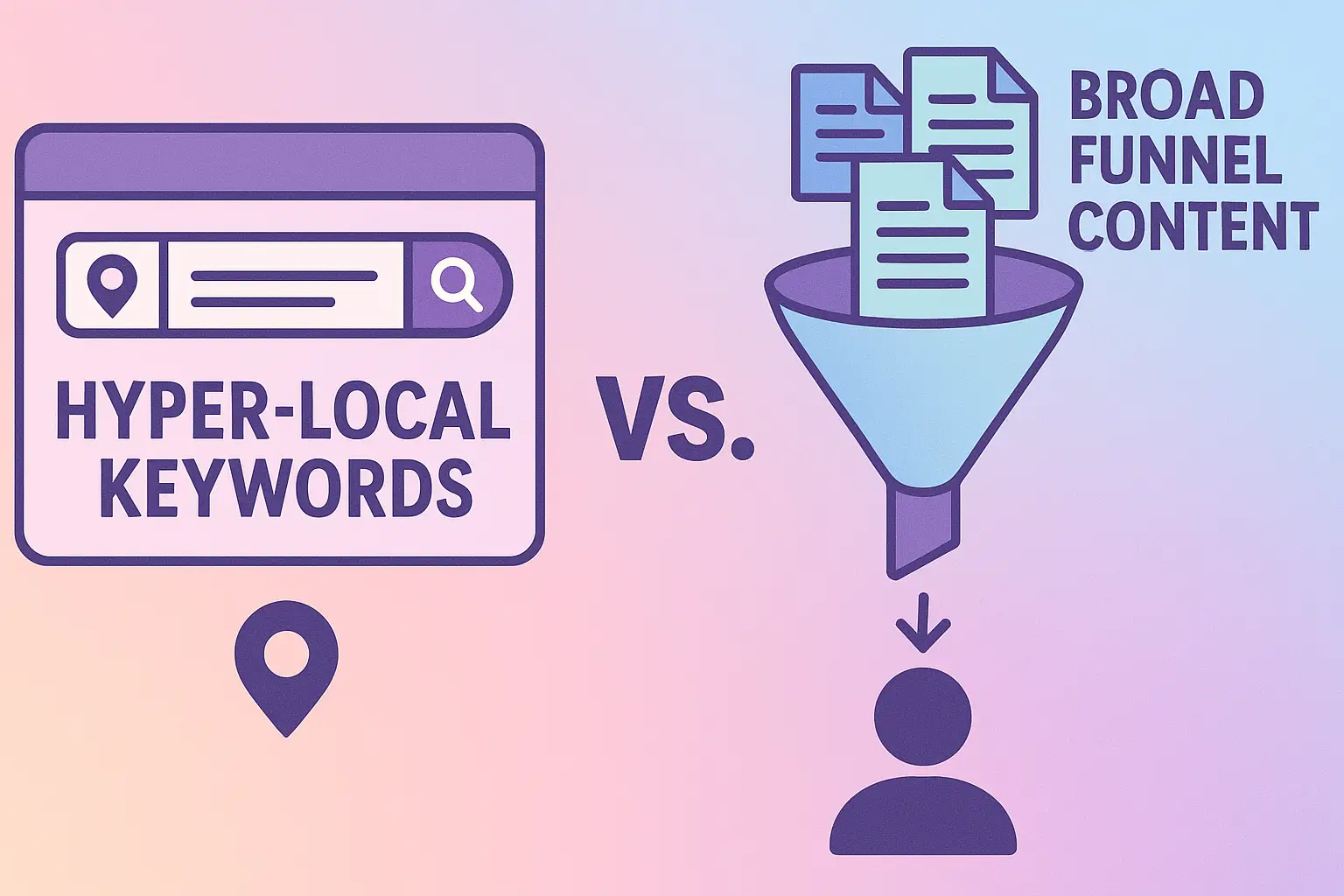
There’s a war brewing in the SEO world.
On one side, local businesses are discovering a tactical goldmine: hyper-local keywords that tools say have “zero” search volume but deliver real, paying customers. On the other, content strategists insist that broad, full-funnel approaches build lasting brand authority. Both camps make compelling arguments. Both have the data to back them up.
So who’s right?
The answer might surprise you. Because in today’s rapidly evolving search landscape—where AI-generated overviews are reshaping how people find information—the businesses winning aren’t picking sides. They’re strategically combining both approaches to capture customers at every stage of their journey.
Let’s break down this debate, examine what actually works, and figure out how your business can leverage both strategies for maximum impact.
The Hyper-Local Revolution: Small Keywords, Big Returns
Hyper-local keyword targeting focuses on ultra-specific geographic queries. We’re talking “plumber in Highland Park Dallas” instead of just “Dallas plumber.” Or “lawyer near Lincoln Park Chicago.” These neighborhood-level, district-specific searches often don’t register in traditional keyword tools.
They show zero volume. No competition metrics. Nothing.
And that’s precisely why they’re so valuable.
The 10-Minute Keyword Research Hack
Here’s where things get interesting. One SEO method making waves skips expensive tools like Ahrefs entirely. Instead, it leverages Google’s own suggestions in a tactical approach that takes about ten minutes.
The process is straightforward:
Start with basic local terms. Type “[your service] [your city]” into Google. For a plumber in Dallas, that’s simply “plumber Dallas.”
Watch the autocomplete dropdown. Those suggestions? They’re real searches people are making. You might see “plumber in Highland Park Dallas” or specific suburb names pop up. Golden opportunities.
Mine the “People Also Ask” section. Questions like “How much does a plumber cost in Dallas?” provide perfect content ideas and reveal what potential customers actually want to know.
Exploit “near me” variations. Try “plumber near _” and let Google fill in the blanks. You’ll discover zip codes, landmarks, and adjacent towns that people commonly search.
Study your competitors. Check their Google Business Profile listings and see which local keywords their sites rank for.
This quick method can generate a comprehensive list of neighborhood-specific keywords without spending a dime on tools. And because most competitors aren’t targeting these ultra-specific phrases, ranking becomes significantly easier.
Why Zero Volume Doesn’t Mean Zero Value
“But why create content for keywords with zero search volume?”
Fair question. Here’s the reality: zero volume doesn’t truly mean zero. It typically means “under 10 searches per month” in a tool’s dataset. Studies on zero-search-volume keywords reveal something crucial—these queries often carry strong commercial intent and face minimal competition.
Think about it. Someone searching “Highland Park plumber” knows exactly what they want. They need a plumber. Now. In their specific neighborhood.
That’s not browsing. That’s buying intent.
For a local service provider, one qualified lead from a “small” neighborhood query can be worth more than dozens of unqualified visits from a broad informational article. These low-volume phrases are easier to rank for and often lead to higher conversion rates despite the low query count.
The Revenue Impact of Local Rankings
The difference between ranking #1 versus #4 in local search results isn’t trivial. One local SEO breakdown illustrated this with hard numbers: a business that fell behind a top competitor for a local term lost approximately 400 calls per year.
At a 33% conversion rate and roughly $500 per job, that’s $66,000 in lost revenue. From weaker local rankings alone.
That’s not hypothetical traffic. It’s actual business walking into your competitor’s door instead of yours.
The Scalability Challenge
Here’s where hyper-local gets tricky. If you operate in a large metro area or serve dozens of neighborhoods, creating a separate page for each location can become overwhelming. And there’s a danger: thin, duplicate content.
Simply swapping out the neighborhood name on an otherwise identical page fifty times? That’s a doorway page strategy Google considers spammy.
Best practices for hyperlocal content emphasize making each location page unique and valuable. Include specific testimonials from that area. Mention local landmarks or events. Tailor the services to that locale. At minimum, aim for a few hundred words of genuine, location-specific information.
Quality over quantity. Always.
The Case for Casting a Wider Net
Now let’s flip the script. Full-funnel content strategies don’t just target “[service] in [city]” keywords. They create content for every stage of the customer journey.
Top-of-funnel (TOFU) might be “DIY fixes for common plumbing issues.” Middle-of-funnel (MOFU) could be “how to choose a reliable plumber in Dallas.” Bottom-of-funnel (BOFU) focuses on conversion: “our plumbing service vs. others – what to expect.”
The philosophy? Cast a wider net. Not everyone starts their search ready to buy.
Building Brand Authority Beyond Transactions
A full-funnel approach builds brand visibility and trust beyond immediate “ready to buy” keywords. Some potential customers start with general questions or problems. If your site provides valuable answers, you attract and nurture those visitors until they’re ready to convert.
This strategy also establishes you as an authority—important for E-E-A-T (Experience, Expertise, Authoritativeness, and Trustworthiness), Google’s quality criteria. Creating content around general topics can earn backlinks and social shares, indirectly boosting your site’s overall SEO strength.
Plus, ranking for “how to unclog a drain” could bring thousands of visitors. Even if most just want DIY tips, a percentage might end up hiring a plumber. At minimum, they’ve now heard of your brand.
The AI Disruption Nobody Saw Coming
But there’s a problem. A big one.
AI-powered search results are changing the game. Google’s Search Generative Experience (SGE) often presents overview answers right on the results page. Users get what they need without clicking through.
How bad is it? Research from Ahrefs found that when Google displays an AI-generated overview, organic clicks drop by approximately 34.5% on average.
Your painstakingly crafted “ultimate guide” content? It might see significantly fewer visitors because users are getting their answers straight from Google’s AI snippet.
This doesn’t mean abandoning informational content. It means evolving it.
Adapting Content for the AI Era
Smart strategies now include optimizing content to be featured in AI answers—so your brand still gets cited or linked. Provide more than what an instant answer can deliver: tools, downloads, or localized information that forces a click-through.
Tactics to increase organic traffic in this new landscape include adding concise “TL;DR” summaries and FAQ schema to pages. This increases the chances that AI or featured snippets draw from your content, potentially driving users to click for more details.
Additionally, broad content can be localized. A blog about “winter plumbing tips in Dallas” ties a general topic to a specific locale, combining funnel content with local relevance.
Finding Your Strategic Balance
So which approach wins? Hyper-local precision or broad funnel focus?
The truth? It depends on your business goals, competition, and resources.
When Hyper-Local Makes Sense
If you’re a service business—plumber, lawyer, locksmith, electrician—in a competitive metro area, creating dedicated pages for each neighborhood or service area is worth the effort. Even with zero predicted traffic, a well-optimized location page can rank and capture those valuable searches.
You don’t want a competitor dominating a local query just because you never targeted it.
Think of hyper-local as covering your bases. These are quick wins that can generate leads with relatively little effort. You’re picking up the opportunities that big competitors overlooked.
When Broad Content Pays Off
A robust content strategy addressing common customer questions and pain points pays dividends in SEO and brand trust. It’s especially important if your industry involves research or comparison—like law firms publishing guides on “what to do after a car accident” to attract potential clients early.
This content fuels your other marketing efforts (social media, email) and supports SEO through internal links and demonstrated expertise.
Just be cognizant of the evolving search landscape. Optimize for featured snippets and AI visibility. Always tie content back to your offerings with clear calls-to-action, so readers know you provide the related service locally.
The Middle Ground Strategy
In online SEO discussions, a middle-ground view has emerged. Use both approaches.
Start with hyper-local methods to identify easy wins and implement those first for quick ROI. Simultaneously, plan a content calendar for broader topics to build long-term growth.
These aren’t either/or strategies. A savvy SEO plan incorporates hyper-local precision for immediate high-intent traffic and broad funnel content for sustained brand growth.
The Future of Local Search
Both approaches must acknowledge that AI-driven search is transforming how people interact with content. If AI increasingly handles simple queries with overview answers, your top-of-funnel content strategy must adapt.
Shift toward creating deeper, more authoritative content. If a user only sees an AI summary, make it compelling enough that they click for full details or unique value. Or focus more on bottom-funnel content that AI won’t directly satisfy.
Here’s the thing (actually, let me rephrase): One could argue that AI makes the case for hyper-local even stronger. A chatbot isn’t going to fix your plumbing or represent you in court. A human is. High-intent local searches will likely remain clicks, not just answers.
Meanwhile, informational content needs differentiation through originality, interactive elements, or sheer expertise to continue pulling in traffic.
Your Action Plan
For most service-oriented businesses, chasing “near me” and neighborhood terms is a smart tactical move that generates leads with relatively little effort. But a holistic funnel strategy provides strategic depth to weather changes in search trends and to educate and engage your audience at every stage.
The most effective approach? Combine them.
Use hyper-local precision to capture immediate demand and fix glaring gaps where you’re not ranking locally. Use broad content to feed the funnel, build your brand’s authority, and capture customers who start their journey with a question instead of a location.
By doing both, you ensure visibility wherever your potential customers are searching—whether it’s a specific neighborhood query with seemingly low volume or a general question that thousands ask on Google every month.
In today’s evolving SEO landscape, that balanced approach yields both quick wins and sustainable growth. Because while the debate between hyper-local and broad funnel continues, the smartest businesses aren’t choosing sides.
They’re winning on both fronts.